
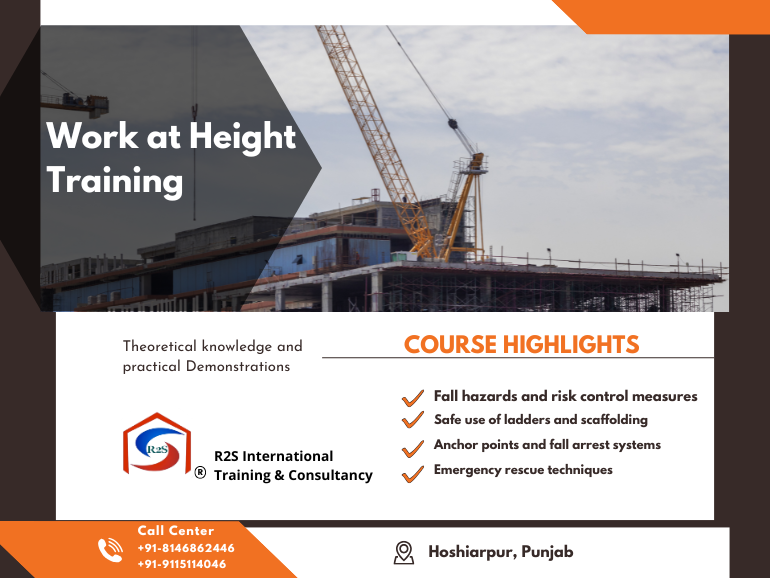
Working at height is common in construction, maintenance, scaffolding, manufacturing, warehouses, telecom, and industrial projects. However, working above ground level can involve serious risks if proper planning, equipment, and safety procedures are not followed.
A professional Work at Height Training Course in Punjab helps workers and supervisors understand fall hazards, personal protective equipment (PPE), safe access systems, inspection procedures, and emergency response.
At R2S International Training & Consultancy (R2SITC), Hoshiarpur, practical safety training is designed to help participants develop the knowledge and awareness required for safer work at height.
What is Work at Height Training?
Work at Height Training is a safety-focused program that teaches workers how to identify and control hazards associated with elevated work.
The training generally covers:
- Fall prevention and protection
- Safe use of ladders and scaffolds
- Safety harnesses and lanyards
- Anchor points and lifelines
- PPE inspection
- Risk assessment
- Safe working procedures
- Emergency and rescue planning
The exact training requirements can vary depending on the job, equipment, workplace, and applicable regulations.
Why is Work at Height Training Important?
Falls from height can cause serious injuries and fatalities. Proper training helps workers recognize hazards before starting a task and understand the correct controls.
Key benefits include:
✅ Improved workplace safety awareness
✅ Better understanding of fall hazards
✅ Correct use of fall protection equipment
✅ Safer ladder and scaffold practices
✅ Improved risk assessment skills
✅ Greater confidence when working at elevated locations
✅ Awareness of emergency and rescue procedures
Who Needs Work at Height Training?
Work at Height Training can be valuable for anyone whose job involves elevated work, including:
- Construction workers
- Scaffolders
- Riggers
- Maintenance workers
- Industrial workers
- Electrical technicians
- Warehouse workers
- Telecom workers
- Supervisors
- Safety professionals
Employers may also require specific training based on the hazards and equipment involved in a particular workplace.
What is Covered in Work at Height Training?
🦺 1. Fall Hazard Identification
Participants learn how to identify potential fall hazards before beginning work.
Examples can include:
- Unprotected edges
- Openings
- Fragile surfaces
- Unsafe ladders
- Improper scaffolding
- Poorly maintained access equipment
Understanding the hazard is the first step toward controlling it.
🪢 2. Safety Harness and Lanyard
Participants learn about the correct selection, inspection, fitting, and use of fall protection equipment.
Training can cover:
- Full-body harnesses
- Lanyards
- Connectors
- Energy-absorbing systems
- Anchorage systems
Equipment should always be used according to the manufacturer’s instructions and workplace procedures.
🪜 3. Ladder Safety
Ladders are commonly used for access and short-duration tasks. Training helps workers understand safe ladder selection, positioning, inspection, and use.
Participants learn why unstable, damaged, or incorrectly positioned ladders can create serious hazards.
🏗️ 4. Scaffold Safety
Scaffolding provides temporary access and working platforms, but it must be properly designed, erected, inspected, and used.
Training may introduce:
- Scaffold components
- Safe access
- Guardrails
- Platforms
- Inspection requirements
- Fall protection
Only competent and authorized personnel should perform tasks that require specialized scaffold expertise.
Risk Assessment Before Working at Height
A major part of safe work is identifying hazards before the task begins.
A basic risk assessment can consider:
- What work needs to be performed?
- How high is the working location?
- What could cause a person to fall?
- Can the work be completed without working at height?
- What fall prevention measures are available?
- What PPE or fall protection system is required?
- What is the emergency rescue plan?
Planning the job before starting can significantly reduce unnecessary risks.
Practical Work at Height Training
Practical training is particularly important because workers need to understand how safety equipment works in real situations.
Hands-on sessions may include:
- Harness fitting
- Harness inspection
- Lanyard connection
- Anchorage awareness
- Ladder safety demonstrations
- Scaffold safety awareness
- Fall protection demonstrations
- Emergency response scenarios
Practical exercises can help participants develop confidence and better understand safe working procedures.
Emergency and Rescue Planning
Fall protection is not only about preventing falls. Organizations should also have appropriate emergency procedures for incidents involving workers at height.
Training can introduce participants to:
- Emergency communication
- Rescue planning
- Safe recovery procedures
- Reporting incidents
- Emergency response responsibilities
A rescue plan should be appropriate to the workplace and carried out by properly trained personnel.
Work at Height Safety Equipment
Depending on the task and workplace, safety equipment may include:
- Full-body harness
- Safety helmet
- Lanyard
- Lifeline
- Anchorage system
- Guardrails
- Safety nets
- Appropriate footwear
- Access equipment
Equipment selection should be based on a proper risk assessment and the specific work environment.
Career Benefits of Work at Height Training
Work at Height Training can add valuable skills for workers in several industries.
It can be useful for professionals working in:
- Construction
- Industrial maintenance
- Infrastructure
- Manufacturing
- Warehousing
- Scaffolding
- Oil & gas
- Power projects
- Telecommunications
For students and job seekers, combining Work at Height Training with courses such as Scaffold Training, Rigger Training, Forklift Training, Fire Safety, or HSE can provide a broader workplace safety skill set.
Why Choose Practical Safety Training?
When choosing a training institute, students should look for:
✅ Experienced instructors
✅ Practical demonstrations
✅ Safety-focused curriculum
✅ Proper training equipment
✅ Realistic workplace scenarios
✅ Emergency response awareness
✅ Course completion certification
Practical learning helps bridge the gap between classroom knowledge and actual workplace requirements.
Start Your Work at Height Training in Punjab
Working at height requires planning, proper equipment, competent workers, and effective safety procedures. Training helps workers understand the hazards and take appropriate precautions before starting elevated work.
If you are a student, fresher, construction worker, industrial employee, scaffolder, rigger, or safety professional, a Work at Height Training Course can be a valuable addition to your professional skills.
Build your knowledge. Improve your safety skills. Work smarter and safer at height.
📍 Work at Height Training in Hoshiarpur, Punjab
R2S International Training & Consultancy (R2SITC)
📍 Hoshiarpur, Punjab
📞 +91-8146862446
📧 [email protected]
Enroll today and gain practical knowledge of fall protection, safe access, PPE, risk assessment, and workplace safety. 🦺🏗️