
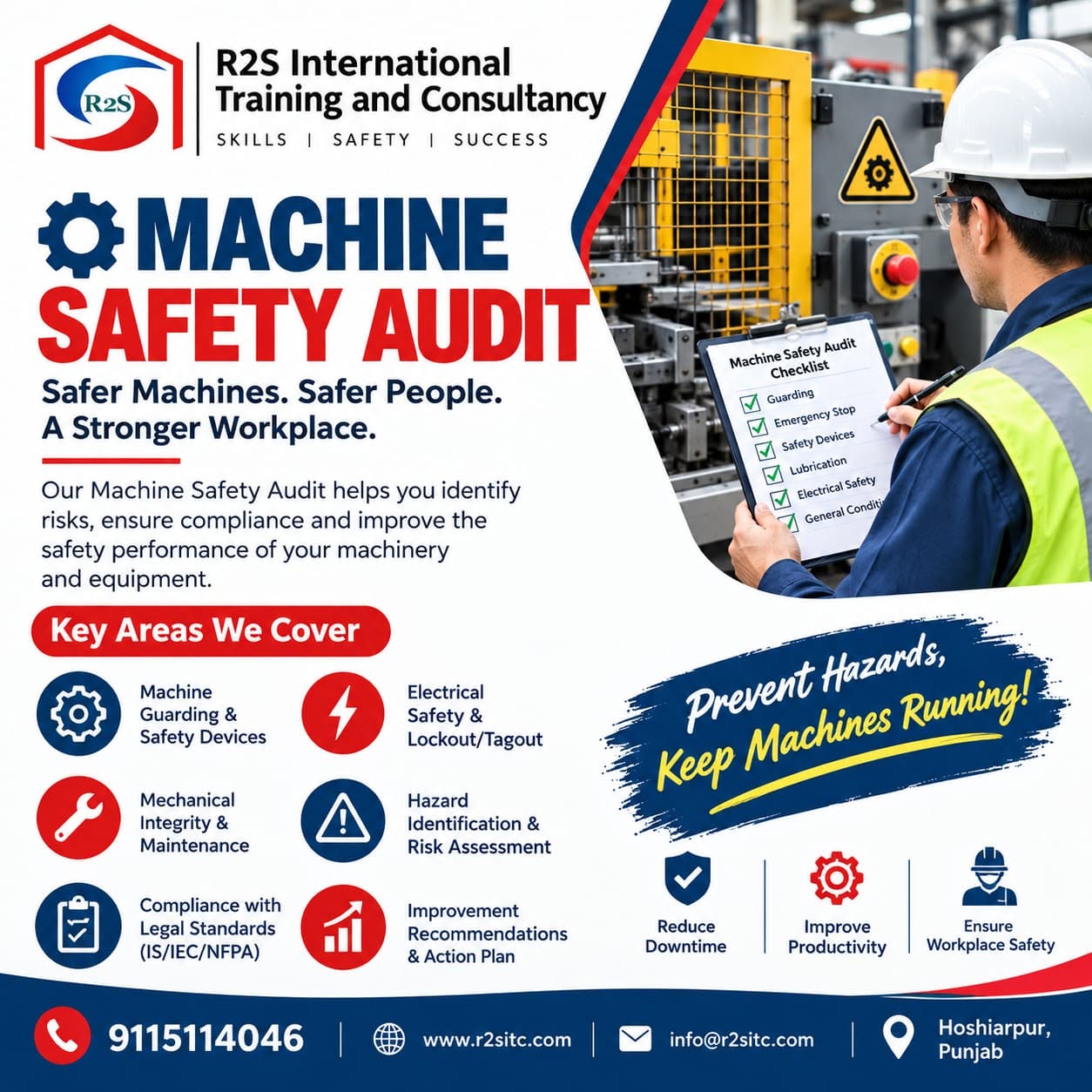
Machines are essential in manufacturing, construction, warehouses, workshops, and other industrial workplaces. However, machinery can also create serious risks when it is poorly maintained, incorrectly operated, inadequately guarded, or used without proper safety procedures.
A Machine Safety Audit is a systematic review of machinery, operating practices, safety controls, and workplace conditions to identify hazards and opportunities for improvement.
For organizations that use industrial equipment, regular machine safety audits can be an important part of a broader workplace safety program.
What Is a Machine Safety Audit?
A Machine Safety Audit involves examining machinery and its associated work processes to determine whether appropriate safety measures are in place.
An audit may look at:
- Machine guards and protective devices
- Emergency stop systems
- Electrical safety
- Operating procedures
- Maintenance practices
- Operator training
- Personal Protective Equipment (PPE)
- Warning signs and labels
- Workplace conditions around machinery
- Lockout/Tagout or energy-isolation procedures
- Inspection and maintenance records
The goal is to identify potential hazards and recommend corrective actions before they contribute to an accident or injury.
Why Is Machine Safety Important?
Industrial machines can involve moving parts, rotating components, cutting tools, crushing points, high temperatures, electricity, pressure, or stored energy.
Common machinery-related hazards include:
- Entanglement
- Crushing
- Cutting
- Shearing
- Impact
- Pinching
- Electrical shock
- Unexpected machine start-up
- Contact with hot surfaces
- Flying particles
- Excessive noise
Proper safety controls can help reduce exposure to these hazards.
What Does a Machine Safety Audit Check?
A detailed audit should examine both the machine itself and the way people interact with it.
1. Machine Guarding
Guards are designed to prevent workers from coming into contact with dangerous moving parts.
Auditors may check whether:
- Guards are installed where required
- Guards are securely fixed
- Guards have not been deliberately removed
- Access to hazardous moving parts is adequately controlled
- Safety devices are functioning as intended
2. Emergency Stop Systems
Emergency stop controls should be appropriately positioned and accessible to workers who may need to use them.
The audit can verify whether emergency-stop devices are clearly identifiable and functioning according to the applicable machine design and workplace procedures.
3. Electrical Safety
Electrical components should be inspected for potential hazards such as damaged cables, exposed conductors, unsuitable connections, or inadequate protection.
Electrical work should be performed by appropriately qualified or authorized personnel.
4. Operating Procedures
Every machine should be operated according to appropriate instructions and established safe-work procedures.
An audit may review whether workers understand:
- Start-up and shutdown procedures
- Machine limitations
- Safe operating methods
- Emergency procedures
- Cleaning requirements
- Maintenance restrictions
5. Lockout/Tagout and Energy Isolation
Machines can contain hazardous energy even after they have been switched off.
Depending on the equipment and workplace requirements, energy sources may include:
- Electrical energy
- Hydraulic pressure
- Pneumatic pressure
- Mechanical energy
- Thermal energy
- Stored or gravitational energy
Proper isolation procedures help prevent unexpected machine movement or start-up during maintenance and servicing.
Operator Training and Competency
Even a well-designed machine can become hazardous when operated incorrectly.
A Machine Safety Audit should therefore consider whether operators have received appropriate training for the equipment they use.
Workers should understand:
- Machine controls
- Operating limitations
- Safety devices
- Required PPE
- Workplace hazards
- Emergency procedures
- Reporting requirements
Refresher training may also be appropriate when equipment, procedures, or working conditions change.
Maintenance and Inspection
Preventive maintenance plays an important role in machine safety.
Organizations should maintain appropriate records for:
- Routine inspections
- Preventive maintenance
- Repairs
- Safety-device checks
- Equipment defects
- Corrective actions
A damaged guard, malfunctioning safety device, unusual machine noise, or other defect should be reported and addressed according to the organization’s procedures.
Risk Assessment During a Machine Safety Audit
A machine audit should not simply identify problems. It should help determine which hazards require attention first.
A basic approach can be:
Identify Hazard → Assess Risk → Determine Controls → Implement Corrective Action → Verify Effectiveness
Where possible, organizations should prioritize engineering and other effective controls rather than relying only on PPE or worker behavior.
Benefits of a Machine Safety Audit
Regular machine safety audits can help organizations:
- Identify machinery hazards
- Improve machine guarding
- Detect unsafe practices
- Strengthen maintenance procedures
- Improve operator awareness
- Identify gaps in safety documentation
- Encourage better hazard reporting
- Reduce exposure to preventable risks
- Support continuous safety improvement
The exact benefits depend on the quality of the audit and how effectively corrective actions are implemented.
Who Can Benefit from Machine Safety Audits?
Machine safety audits can be valuable for workplaces that operate:
- Manufacturing machinery
- Production equipment
- Material-handling equipment
- Industrial machines
- Workshop equipment
- Processing machinery
- Packaging equipment
- Construction-related machinery
- Automated or semi-automated systems
They can also be useful when introducing new machinery, modifying existing equipment, investigating recurring safety concerns, or reviewing workplace safety programs.
Machine Safety Audit Training
Professionals working in occupational health and safety can benefit from understanding how machinery hazards are identified, assessed, and controlled.
Training in Machine Safety Audit can help participants develop knowledge of:
- Machine hazard identification
- Safety inspection techniques
- Guarding principles
- Risk assessment
- Safe operating procedures
- Emergency controls
- Energy isolation
- PPE requirements
- Audit documentation
- Corrective and preventive actions
These skills can complement broader Industrial Safety, HSE, Safety Officer, and Workplace Safety training.
Machine Safety in the Workplace
Machine safety is a shared responsibility. Management must provide appropriate systems and resources, supervisors must monitor safe practices, and workers must follow procedures and report unsafe conditions.
A successful machine safety program combines:
Safe Machine Design + Effective Safeguards + Proper Training + Regular Inspection + Preventive Maintenance + Safe Work Procedures
Conclusion
A Machine Safety Audit is more than a checklist exercise. It is an opportunity to examine how machinery is designed, maintained, operated, and managed within the workplace.
By identifying hazards early and following up with effective corrective actions, organizations can work toward safer machinery operations and a stronger overall safety culture.
For individuals interested in developing industrial safety and auditing skills, R2S International Training & Consultancy offers safety-focused training programs in Hoshiarpur, Punjab.
Road 2 Safety International Training & Consultancy (R2SITC)
Address: Hoshiarpur Punjab, India
Phone: +91-8146862446,
+91-9115113846,
Tel: 01882 253146
Email: [email protected]
Understand the machine. Identify the hazard. Control the risk. Work safely.