
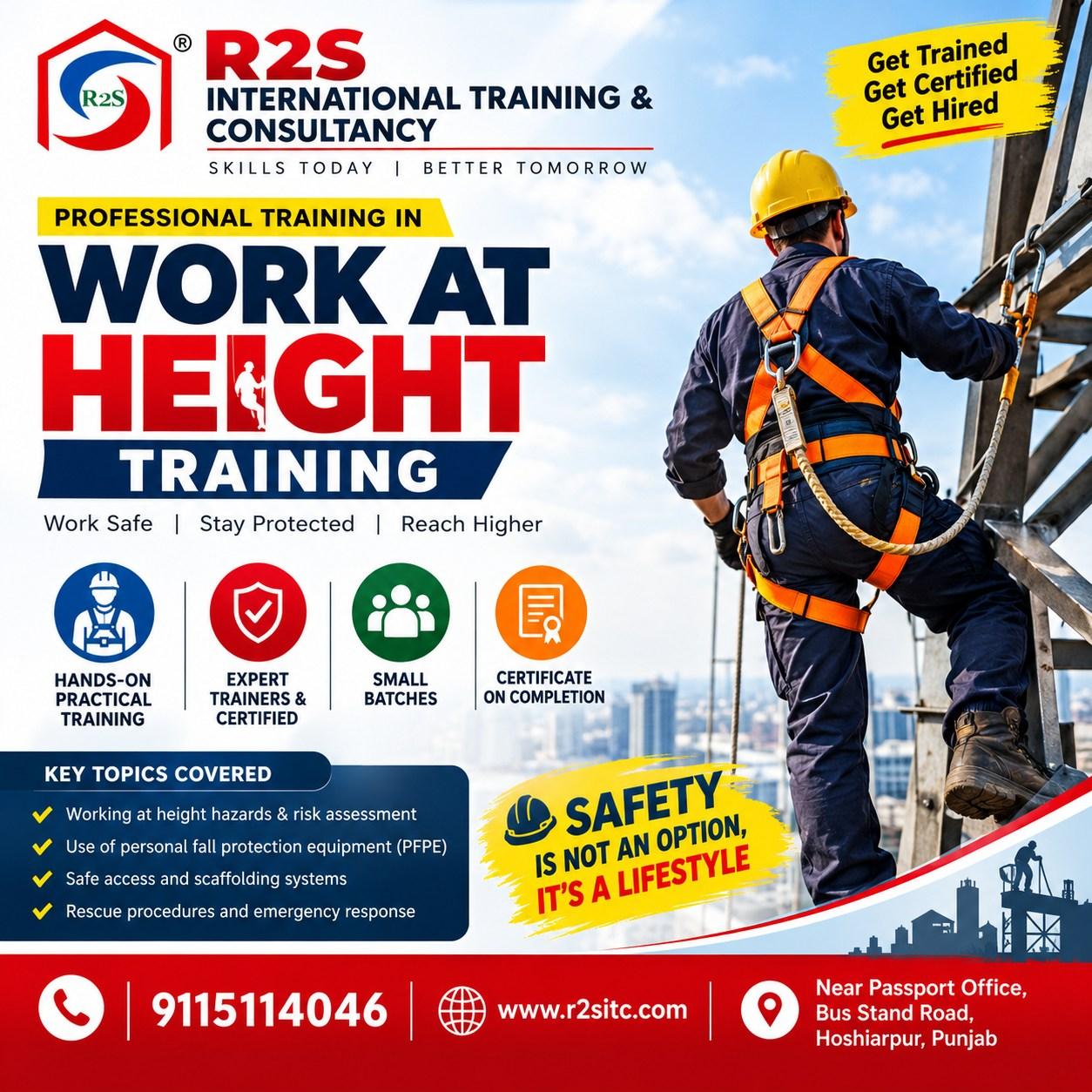
Working at height is a regular part of many industries, including construction, scaffolding, manufacturing, electrical maintenance, warehousing, telecommunications and infrastructure development. Employees may need to work on ladders, rooftops, elevated platforms, scaffolds or other raised surfaces to complete their daily responsibilities.
Although these activities are common, they can expose workers to serious risks if proper safety precautions are not followed. A fall from height can result in severe injuries or even fatalities. Unsafe access, damaged equipment, unprotected edges, poor planning and a lack of training are some of the factors that can contribute to accidents.
Work at Height Safety Training in Punjab helps workers and supervisors understand these risks and develop the knowledge required to follow safer working procedures. At R2S International Training & Consultancy (R2SITC), Hoshiarpur, safety-focused training helps participants build awareness of fall hazards, protective equipment and workplace safety practices.
What Does Working at Height Mean?
Working at height generally refers to any work activity where a person could fall a distance that may cause personal injury if appropriate precautions are not in place.
It is not limited to working on tall buildings or construction structures. Even relatively low-level activities can create fall risks when workers use unsafe platforms, access equipment or elevated surfaces.
Common examples include:
-
Working on construction scaffolding.
-
Carrying out repairs on rooftops.
-
Installing electrical cables and equipment.
-
Maintaining industrial machinery at elevated positions.
-
Working on ladders or mobile elevated platforms.
-
Performing maintenance on communication towers.
-
Accessing elevated storage areas in warehouses.
The level of protection required depends on the work activity, surrounding environment, equipment and risk assessment.
Why Is Work at Height Safety Training Important?
Workers may sometimes underestimate the risks involved in elevated work, particularly when performing routine tasks. However, familiarity with a job does not remove its hazards.
Proper training helps participants understand how to identify risks, select suitable equipment and follow workplace safety procedures.
Important benefits include:
1. Better Identification of Fall Hazards
Workers learn to recognize hazards such as unprotected edges, open floor openings, fragile roof surfaces, unstable ladders, incomplete scaffolding and slippery working areas.
Identifying these hazards before beginning a task allows appropriate precautions to be planned.
2. Improved Understanding of Safety Equipment
Fall protection equipment must be suitable for the work and used correctly. Training introduces participants to equipment such as full-body harnesses, lanyards, connectors, lifelines and suitable anchorage systems.
Workers should understand the equipment’s purpose, limitations, inspection requirements and manufacturer’s instructions.
3. Safer Use of Ladders and Scaffolds
Incorrect ladder positioning, damaged components, unstable platforms and unsafe access can increase the possibility of falls.
Training helps workers understand the importance of equipment inspection, safe access, platform conditions and following approved procedures.
4. Greater Awareness of Workplace Responsibilities
Working safely at height is not only the responsibility of the individual worker. Employers, supervisors and safety personnel also have important roles in planning, supervision, equipment selection and risk control.
Training helps build a shared understanding of workplace safety responsibilities.
Essential Safety Checks Before Starting Work at Height
Before beginning an elevated task, workers and supervisors should make sure that the activity has been properly planned and the necessary precautions are available.
The following checks are important.
1. Assess the Work Area
Inspect the location where the task will take place. Look for unprotected edges, openings, fragile surfaces, electrical hazards, poor lighting, slippery areas and overhead risks.
A suitable risk assessment should be completed before work begins.
2. Check Access Equipment
Ladders, scaffolds, platforms and other access equipment should be appropriate for the task.
Check for visible damage, stability, correct installation and any inspection requirements. Equipment that is damaged or unsafe should not be used until it has been assessed and made safe.
3. Inspect Personal Protective Equipment
Where personal fall protection is required, check the relevant equipment before use. This may include:
-
Full-body safety harnesses.
-
Lanyards and connectors.
-
Energy-absorbing devices.
-
Lifelines and suitable anchorage arrangements.
-
Safety helmets and other task-specific PPE.
Follow the manufacturer’s inspection guidance and workplace procedures. Equipment showing damage, defects or signs of deterioration should be removed from service in accordance with the applicable procedure.
4. Confirm Weather and Environmental Conditions
Outdoor work can be affected by strong winds, rain, lightning, poor visibility and slippery surfaces.
Supervisors should assess changing conditions and postpone or stop work when the environment makes the activity unsafe.
5. Confirm Emergency and Rescue Arrangements
A work-at-height plan should consider what happens if a worker falls or becomes suspended in a harness.
The workplace should have suitable emergency arrangements, trained responders where required, appropriate rescue equipment and a clear communication process. Simply wearing a harness is not a complete rescue plan.
Understanding Fall Prevention and Fall Protection
Fall prevention and fall protection are related, but they do not mean exactly the same thing.
Fall prevention focuses on stopping a fall from happening. Examples include guardrails, safe working platforms, edge protection and suitable access systems.
Fall protection includes measures and equipment intended to protect a worker when a fall hazard cannot be fully eliminated. Depending on the task, this may involve personal fall protection systems and other suitable protective arrangements.
A key safety principle is to consider whether work at height can be avoided first. If it cannot, employers should prioritize measures that prevent falls before relying on personal fall arrest equipment alone.
Important Topics Covered in Work at Height Training
A structured Work at Height Training Course can help participants understand the following subjects:
| Training topic | What participants learn |
|---|---|
| Hazard identification | Recognizing fall risks and unsafe work conditions |
| Risk assessment | Understanding hazards and selecting suitable precautions |
| Ladder safety | Safe selection, inspection, positioning and use |
| Scaffold safety | Understanding safe platforms, access and inspection requirements |
| Harness awareness | Correct fitting, inspection and equipment limitations |
| Fall protection systems | Understanding connectors, lifelines and anchorage |
| PPE awareness | Selecting and using task-appropriate protective equipment |
| Emergency preparedness | Understanding reporting, rescue planning and response procedures |
The exact syllabus and practical activities should be confirmed with the training provider and matched to the work participants are expected to perform.
Who Should Consider Work at Height Training?
This training can be valuable for people whose responsibilities involve elevated work or supervising activities where fall hazards may be present.
It may be relevant to:
-
Construction workers and site personnel.
-
Scaffolders and scaffolding supervisors.
-
Riggers and lifting teams.
-
Industrial maintenance workers.
-
Electrical technicians.
-
Telecom tower workers.
-
Warehouse and facility maintenance staff.
-
Safety officers and supervisors.
-
Contractors involved in elevated work.
New entrants can also benefit from learning basic safety principles before entering workplaces where work at height is required.
Common Work at Height Safety Mistakes to Avoid
Some workplace incidents occur because workers or supervisors overlook basic safety precautions.
Common mistakes include:
-
Using damaged or unsuitable ladders.
-
Standing on unstable surfaces.
-
Overreaching while working from a ladder.
-
Using a harness without checking the complete fall protection system.
-
Connecting equipment to an unsuitable anchorage point.
-
Ignoring inspection requirements.
-
Working near fragile surfaces without appropriate precautions.
-
Failing to protect people below from falling objects.
-
Starting work without understanding emergency arrangements.
Workers should follow approved site procedures and never improvise a fall protection arrangement.
How to Choose a Work at Height Training Institute in Punjab
Choosing suitable training is an important step for anyone who wants to develop workplace safety knowledge.
Before enrolling, consider the following:
-
Course syllabus: Check whether the program covers hazard identification, fall prevention, PPE, ladders, scaffolds and emergency awareness.
-
Practical learning: Ask whether demonstrations or suitable hands-on activities are included.
-
Trainer knowledge: Understand the instructors’ relevant experience and training background.
-
Equipment awareness: Confirm whether participants learn about the equipment used in their intended work environment.
-
Assessment and certification: Ask about assessment methods, completion requirements and certificate details.
-
Course suitability: Confirm that the training matches your experience level and workplace responsibilities.
A training certificate should not be treated as automatic authorization to perform every type of elevated work. Specific tasks may require additional competency assessments, specialized instruction and employer or site authorization.
Work at Height Training in Hoshiarpur, Punjab – R2SITC
R2S International Training & Consultancy (R2SITC), located in Hoshiarpur, Punjab, provides safety-focused training opportunities for individuals interested in workplace and industrial safety.
The Work at Height Training course is relevant to learners who want to improve their understanding of fall hazards, safety equipment, safe access practices and emergency preparedness.
Whether you are a construction worker, scaffolder, maintenance professional, industrial employee or aspiring safety professional, developing work-at-height safety knowledge can support safer working practices.
Before enrolling, contact the institute to confirm the latest course syllabus, duration, practical training arrangements, assessment process and certificate details.
Build Safer Skills with R2SITC
R2S International Training & Consultancy (R2SITC)
-
Location: Hoshiarpur, Punjab, India
-
Phone: +91-8146862446
-
Email: [email protected]
-
Website: https://www.r2sitc.com/
Contact R2SITC to enquire about Work at Height Training and other industrial safety courses.
Frequently Asked Questions (FAQs)
1. What is Work at Height Training?
Work at Height Training teaches participants how to identify fall hazards, understand fall prevention methods, use relevant safety equipment and follow safer procedures when working at elevated locations.
2. Who should attend a Work at Height Training Course?
Construction workers, scaffolders, riggers, maintenance staff, electrical technicians, telecom workers, supervisors and safety professionals involved in elevated work may benefit from this training.
3. Does Work at Height Training include safety harness awareness?
A suitable course may cover full-body harnesses, lanyards, connectors, anchorage systems, inspection and correct use. Participants should confirm the exact syllabus with the training institute.
4. Why is risk assessment important before working at height?
Risk assessment helps identify potential fall hazards and determine suitable precautions before work begins. It supports better planning, equipment selection and supervision.
5. Is ladder safety included in work-at-height safety?
Ladder safety is an important subject. Workers should understand ladder selection, inspection, positioning, stability, safe access and the limitations of ladder use.
6. Is practical training important for work at height?
Yes. Suitable practical demonstrations and supervised exercises can help participants understand equipment, inspection procedures and safe working practices. Practical training should match the equipment and tasks involved.
7. Where can I enquire about Work at Height Training in Punjab?
You can contact R2S International Training & Consultancy (R2SITC) in Hoshiarpur, Punjab, at +91-8146862446 or [email protected] for current course information.
Conclusion
Working at height requires more than basic equipment. It involves proper planning, hazard identification, suitable protective systems, competent supervision and emergency preparedness.
A structured Work at Height Safety Training Course in Punjab can help workers and supervisors understand these important principles and develop safer workplace habits.
If you want to improve your knowledge of fall prevention, PPE, ladder safety, scaffold awareness and emergency procedures, contact R2SITC Hoshiarpur to learn about its available training options.