
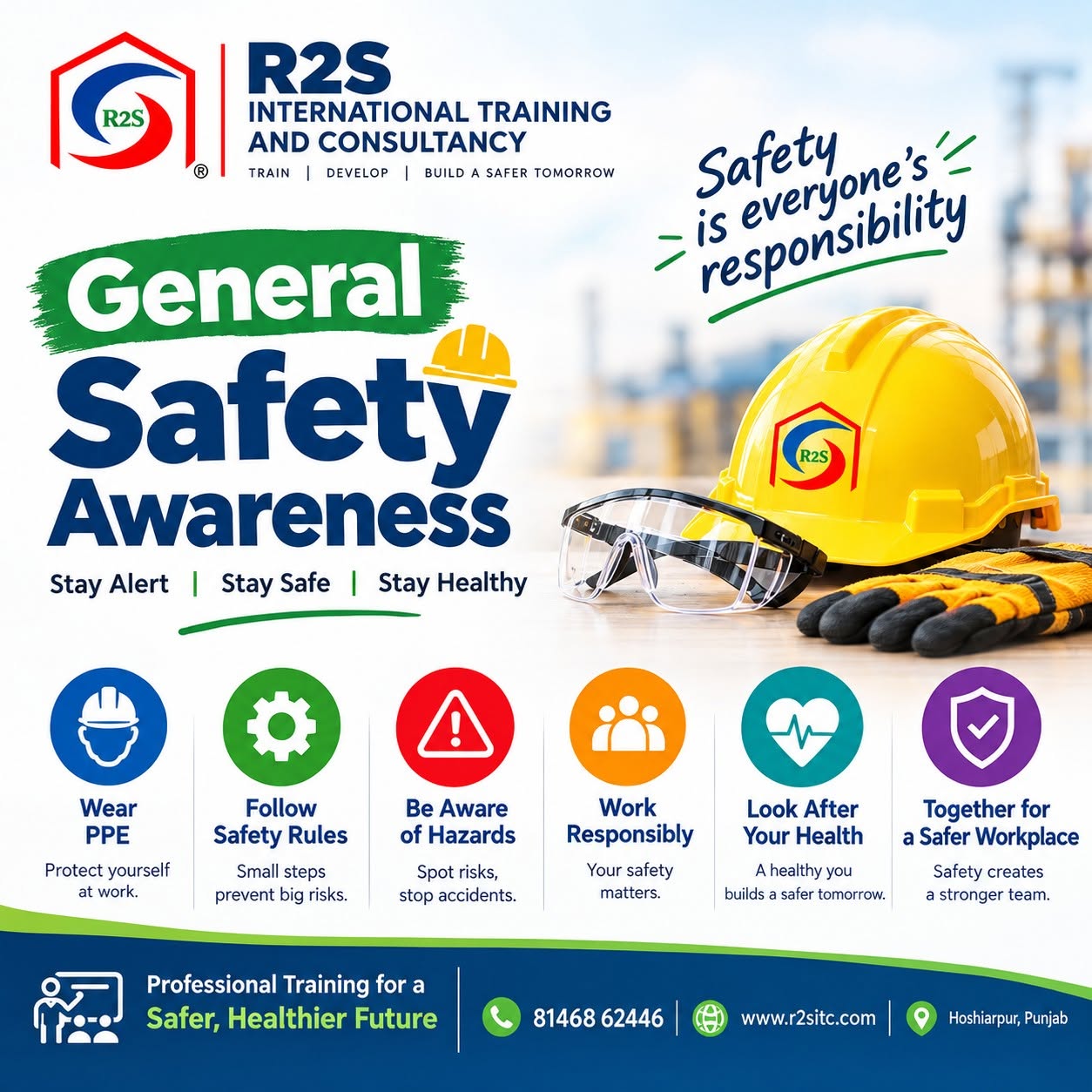
Workplace safety is not the responsibility of only safety officers or supervisors. Every employee, worker, contractor, and visitor has a role to play in maintaining a safe working environment. General Safety Awareness training helps people recognize common hazards, follow safe work practices, use personal protective equipment correctly, and respond appropriately during emergencies.
Whether you work in construction, manufacturing, warehouses, offices, logistics, maintenance, or other industrial environments, basic safety knowledge can help prevent accidents and injuries.
What Is General Safety Awareness?
General Safety Awareness is an introduction to the basic principles of workplace health and safety. It helps workers understand how accidents happen and what they can do to reduce workplace risks.
The training generally focuses on:
- Identifying workplace hazards
- Understanding safe working procedures
- Using Personal Protective Equipment (PPE)
- Reporting unsafe conditions
- Maintaining good housekeeping
- Emergency preparedness
- Fire safety awareness
- Safe use of tools and equipment
- Manual handling practices
- Electrical safety awareness
- Working at height awareness
- Accident and incident reporting
The objective is to develop a safety-first mindset among workers.
Why Is General Safety Awareness Important?
Many workplace accidents can occur because of unsafe conditions, unsafe actions, inadequate training, poor housekeeping, or failure to follow established procedures.
Safety awareness encourages workers to think before starting a task:
Identify the Hazard → Assess the Risk → Follow Safe Procedures → Use Proper PPE → Perform the Task Safely → Report Problems
This approach can help employees recognize potential risks before they become accidents.
Common Workplace Hazards
Workers can encounter different types of hazards depending on their workplace.
1. Slips, Trips and Falls
Wet floors, uneven surfaces, loose cables, obstructed walkways, and poor housekeeping can create unnecessary risks.
Workers should keep walkways clear, clean spills promptly, and report unsafe flooring or access conditions.
2. Electrical Hazards
Damaged cables, exposed electrical components, overloaded sockets, and improper use of electrical equipment can create serious hazards.
Only authorized and appropriately trained personnel should carry out electrical work.
3. Fire Hazards
Flammable materials, electrical faults, poor storage practices, and ignition sources can contribute to workplace fires.
Employees should know the location of emergency exits, alarms, fire extinguishers, and designated assembly areas.
4. Manual Handling
Lifting or moving heavy materials incorrectly can cause strains and other injuries.
Workers should understand proper lifting techniques and use mechanical assistance when appropriate.
5. Machinery and Equipment
Moving machinery, rotating parts, sharp edges, and improperly guarded equipment can create significant hazards.
Workers should follow operating instructions and never remove safety guards or bypass safety devices.
6. Chemical Hazards
Some workplaces use chemicals that may be harmful if they are inhaled, swallowed, or come into contact with the skin or eyes.
Proper labeling, storage, handling procedures, PPE, and emergency information are important when working with hazardous substances.
7. Working at Height
Ladders, scaffolds, platforms, roofs, and elevated work areas require additional precautions because falls can result in serious injuries.
Workers should follow approved procedures and use appropriate fall-prevention or fall-protection systems where required.
Personal Protective Equipment (PPE)
PPE provides an important layer of protection when workplace hazards cannot be completely eliminated.
Depending on the task, PPE may include:
- Safety helmets
- Safety shoes
- Safety glasses
- Gloves
- Hearing protection
- Respiratory protection
- High-visibility clothing
- Safety harnesses
Workers should understand which PPE is required, how to wear it correctly, and how to inspect it before use.
Importance of Good Housekeeping
Good housekeeping is one of the simplest ways to improve workplace safety.
A clean and organized workplace can help reduce:
- Slip and trip hazards
- Blocked emergency exits
- Poor material storage
- Fire risks
- Obstructed work areas
- Unnecessary equipment damage
Tools and materials should be stored properly, waste should be removed regularly, and emergency routes should remain accessible.
Emergency Preparedness
Every workplace should have procedures for dealing with emergencies.
General safety awareness should help workers understand what to do during situations such as:
- Fire
- Medical emergencies
- Chemical spills
- Equipment incidents
- Electrical emergencies
- Evacuation situations
Employees should know how to raise an alarm, whom to contact, where to evacuate, and where to assemble according to their workplace emergency procedures.
Safety Reporting and Communication
Employees should feel encouraged to report hazards, near misses, unsafe behavior, damaged equipment, and other safety concerns.
Reporting a hazard early gives management and safety teams an opportunity to take corrective action before an incident occurs.
Effective safety communication between workers, supervisors, contractors, and management is therefore an important part of workplace safety.
Who Should Attend General Safety Awareness Training?
General Safety Awareness training can be useful for:
- New employees
- Students and freshers
- Construction workers
- Factory workers
- Warehouse employees
- Logistics personnel
- Maintenance workers
- Supervisors
- Contractors
- Office and support staff
- Employees who need workplace safety refresher training
Build a Strong Safety Culture
Workplace safety is more than wearing a helmet or putting up warning signs. A strong safety culture develops when everyone takes responsibility for identifying hazards, following procedures, communicating concerns, and looking after their own safety as well as the safety of others.
Safety Awareness → Better Hazard Recognition → Safer Decisions → Fewer Unsafe Practices → Safer Workplace
General Safety Awareness Training in Punjab
For organizations and individuals looking to strengthen their understanding of workplace safety, R2S International Training & Consultancy provides safety-focused training programs covering general workplace safety and related industrial safety subjects.
General Safety Awareness is a valuable starting point for anyone who wants to develop better safety habits and understand the fundamentals of working safely.
 R2SITC – Hoshiarpur, Punjab
R2S International Training & Consultancy (R2SITC)
Hoshiarpur, Punjab +91-8146862446
 [email protected]
Learn safety. Recognize hazards. Follow procedures. Protect yourself and others.