
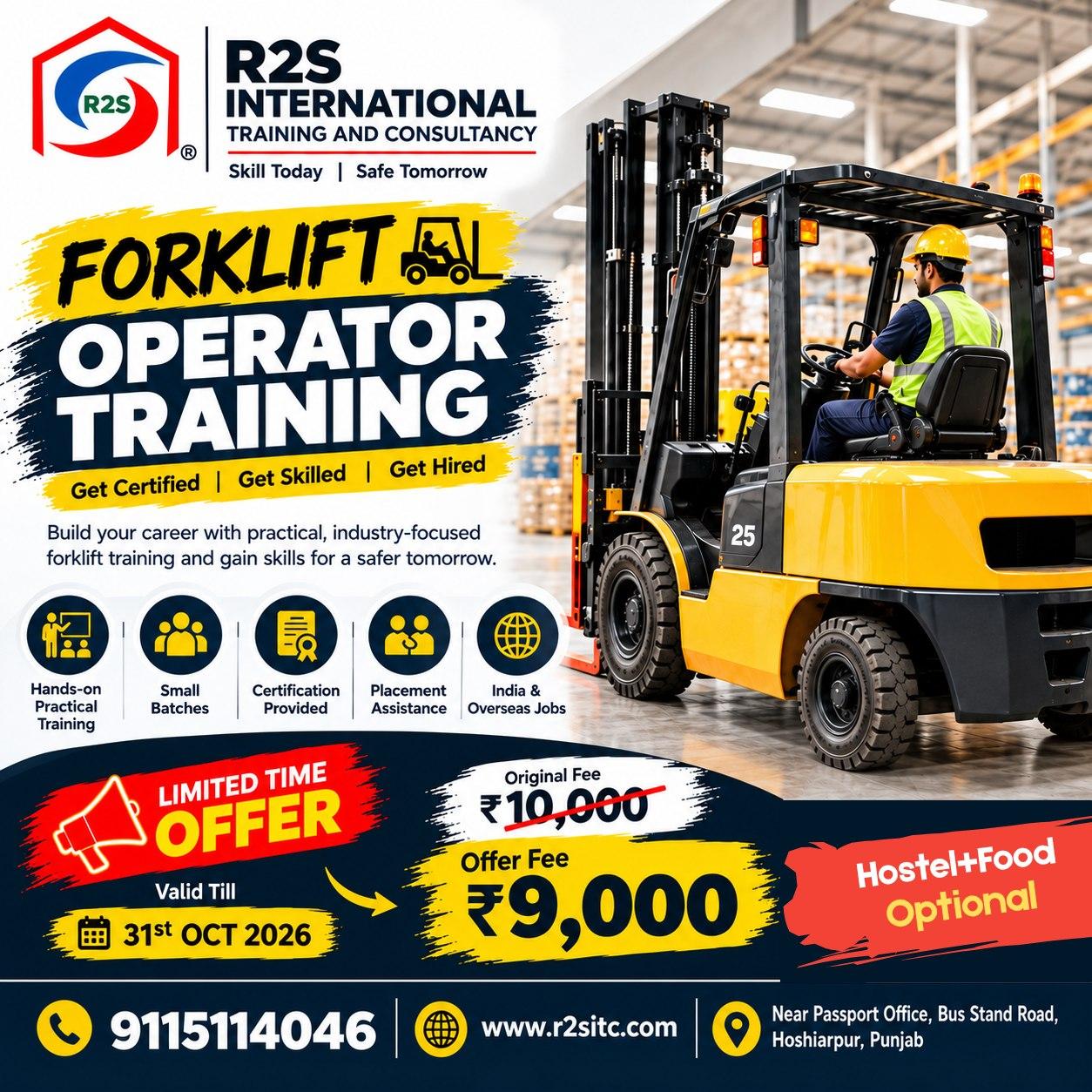
Forklifts are widely used in warehouses, factories, construction sites, distribution centres and other industrial workplaces. These machines help move heavy materials, load goods, unload deliveries and organise stock efficiently. However, operating a forklift requires more than simply knowing how to drive a vehicle.
Operators must understand equipment controls, load stability, workplace hazards, pedestrian safety and proper operating procedures. Without suitable training, incorrect forklift operation can lead to damaged goods, equipment collisions, falling loads and serious workplace injuries.
Forklift Training in Punjab helps learners develop the knowledge and practical skills needed to understand forklift operation and workplace safety. At R2S International Training & Consultancy (R2SITC), Hoshiarpur, learners can enquire about forklift training to build their understanding of safe material handling and equipment operation.
What Is Forklift Training?
Forklift training is a learning programme designed to teach individuals the principles of operating and handling forklift equipment safely.
Depending on the course structure and equipment available, training may include theoretical instruction, practical demonstrations and supervised operating exercises.
Key learning areas can include:
-
Understanding forklift components and controls.
-
Conducting pre-operation inspections.
-
Understanding load capacity and stability.
-
Safe lifting, lowering and stacking procedures.
-
Moving and positioning materials.
-
Identifying workplace hazards.
-
Maintaining awareness of pedestrians and other vehicles.
-
Parking and shutting down equipment correctly.
The purpose of training is to help learners understand how to operate equipment responsibly and recognise situations that may create risks.
Why Is Forklift Operator Training Important?
Forklifts carry heavy loads and often operate in areas where workers, vehicles, shelves and stored materials are nearby. Even a small operating mistake can have serious consequences.
Proper training helps operators understand common risks and follow appropriate safety procedures.
1. Improved Workplace Safety
Training introduces operators to hazards such as unstable loads, restricted visibility, slippery floors, uneven surfaces and pedestrian traffic.
Recognising these hazards helps operators make safer decisions before and during equipment operation.
2. Better Load Handling
Forklift operators need to understand how to pick up, transport and place loads without compromising equipment stability.
Training can cover load positioning, centre of gravity, load limits and the importance of keeping loads secure during movement.
3. Correct Use of Equipment
Understanding the controls and operating characteristics of a forklift helps learners avoid inappropriate manoeuvres and unsafe handling practices.
Operators should use only equipment they have been trained and authorised to operate.
4. Reduced Risk of Equipment and Material Damage
Incorrect lifting, turning or stacking can damage goods, storage racks and machinery. Safe operating procedures help workers handle materials more carefully and reduce avoidable risks.
5. Better Workplace Awareness
Forklift operators must pay attention to pedestrians, blind spots, warning signs, travel routes and changing site conditions. Training helps reinforce the importance of communication and awareness in busy working environments.
What Do You Learn in a Forklift Training Course?
A forklift course may cover the following topics, depending on the provider’s curriculum and practical facilities.
Forklift Components and Controls
Learners are introduced to important forklift components, including the forks, mast, lifting mechanism, steering system, brakes and operating controls.
Understanding these components helps operators recognise how the machine works and why correct operation matters.
Pre-Operation Inspection
Equipment should be checked before use according to the manufacturer’s instructions and workplace procedures.
Typical inspection points may include:
-
Tyres and wheels.
-
Brakes and steering.
-
Forks, mast and lifting mechanism.
-
Hydraulic hoses and visible leaks.
-
Lights, horn and warning devices.
-
Seat belt and other fitted safety features.
-
Battery or fuel system, as applicable.
Any defect that could affect safe operation should be reported, and unsafe equipment should not be used until appropriately addressed.
Safe Lifting and Load Handling
One of the most important aspects of forklift operation is understanding how loads affect stability.
Learners should understand the importance of checking the load weight, keeping it within the forklift’s rated capacity, positioning it correctly and avoiding sudden movements.
Driving, Turning and Manoeuvring
Training may include moving forward and in reverse, turning, positioning the forklift and manoeuvring in designated areas.
Operators must adjust their speed to the surroundings, maintain clear visibility and follow the workplace’s traffic management procedures.
Stacking and Unloading
Correct stacking helps prevent falling materials and damage to goods or storage structures.
Learners may be introduced to safe load placement, suitable approach techniques, keeping people clear of lifting operations and following site-specific stacking rules.
Pedestrian and Workplace Safety
Forklifts often work around people and other moving equipment. Training should reinforce safe travel routes, speed limits, warning signals, visibility requirements and communication with nearby workers.
Parking and Shutdown Procedures
At the end of an operating task, the forklift should be parked in an approved location and secured according to the manufacturer’s instructions and workplace procedures. This commonly includes lowering the forks, applying the parking brake and switching off the equipment.
Who Should Consider Forklift Training?
Forklift training may be useful for people who want to learn about material handling equipment or improve their workplace skills.
Suitable learners may include:
-
Students and freshers exploring industrial occupations.
-
Job seekers interested in warehouse or material handling roles.
-
Warehouse and logistics workers.
-
Factory and manufacturing employees.
-
Workers involved in loading and unloading materials.
-
Employees whose duties require forklift operation.
Course suitability depends on the learner’s experience, the equipment involved and the training provider’s entry requirements. Employers must also ensure that operators meet applicable legal, workplace and equipment-specific requirements.
Career Opportunities After Forklift Training
Forklift operation is relevant to several industries where materials need to be moved, stored or transported.
Potential work environments include:
-
Warehouses and distribution centres.
-
Manufacturing and production facilities.
-
Logistics and supply chain operations.
-
Industrial storage and material handling.
-
Construction material yards.
-
Shipping, receiving and goods-handling departments.
Relevant job titles may include forklift operator, warehouse equipment operator and material handling operator. Actual job eligibility depends on the employer’s requirements, experience, applicable authorisations and the candidate’s practical skills.
Important: Completing a training course does not guarantee employment. Learners should confirm what training records, assessments or operator authorisations are provided and whether these meet the requirements of their intended workplace.
How to Choose the Right Forklift Training Institute in Punjab
Before enrolling in a forklift course, consider the following points:
1. Practical learning opportunities: Ask whether the programme includes supervised practice on suitable equipment.
2. Experienced trainers: Check whether instructors can explain operating procedures, common hazards and safe material handling.
3. Safety-focused curriculum: Look for topics such as pre-use inspections, load stability, pedestrian awareness and emergency procedures.
4. Suitable equipment and facilities: Confirm which forklift types are available and whether the training matches your learning objectives.
5. Course duration and assessment: Ask about the training schedule, practical assessment and any certificate or training record issued upon completion.
6. Transparent course details: Confirm fees, entry requirements, facilities and what is included before enrolling.
Choosing a programme based on practical learning and safety standards can help learners make a more informed decision.
Forklift Training at R2SITC, Hoshiarpur, Punjab
R2S International Training & Consultancy (R2SITC) provides training-related learning opportunities in Hoshiarpur, Punjab. People interested in forklift operation can contact the institute to learn about the available course structure, practical sessions, duration, fees and training documentation.
Whether you are a fresher exploring industrial skills or a worker looking to develop your material handling knowledge, understanding safe forklift operation is an important step towards responsible workplace practices.
Contact R2SITC to discuss your training requirements.
-
Institute: R2S International Training & Consultancy (R2SITC)
-
Location: Hoshiarpur, Punjab, India
-
Phone: +91-8146862446
-
Email: [email protected]
-
Website: https://r2sitc.com
Frequently Asked Questions (FAQs)
1. What is forklift training?
Forklift training teaches learners about forklift controls, equipment inspections, safe load handling, manoeuvring, workplace hazards and operating procedures.
2. Where can I enquire about forklift training in Punjab?
You can contact R2SITC in Hoshiarpur, Punjab, through r2sitc.com or by calling +91-8146862446 to ask about available training programmes.
3. Is practical training important for forklift operators?
Yes. Practical instruction and supervised assessment help learners understand equipment handling, operating controls, load movement and workplace safety. The required training depends on the equipment and applicable workplace rules.
4. Can freshers join a forklift training course?
Many training programmes are designed for beginners, but entry requirements vary. Contact the training provider to confirm eligibility, course duration and the practical learning included.
5. What safety topics are covered in forklift training?
Topics may include pre-operation checks, load capacity, stability, safe lifting, pedestrian awareness, manoeuvring, parking and reporting equipment defects.
6. Does completing forklift training guarantee a job?
No. Training can help learners develop relevant knowledge and skills, but employment depends on job availability, employer requirements, experience and any required authorisation.
7. How do I choose a forklift training course?
Compare the practical training offered, trainer experience, equipment availability, safety curriculum, assessment process and course documentation before enrolling.