
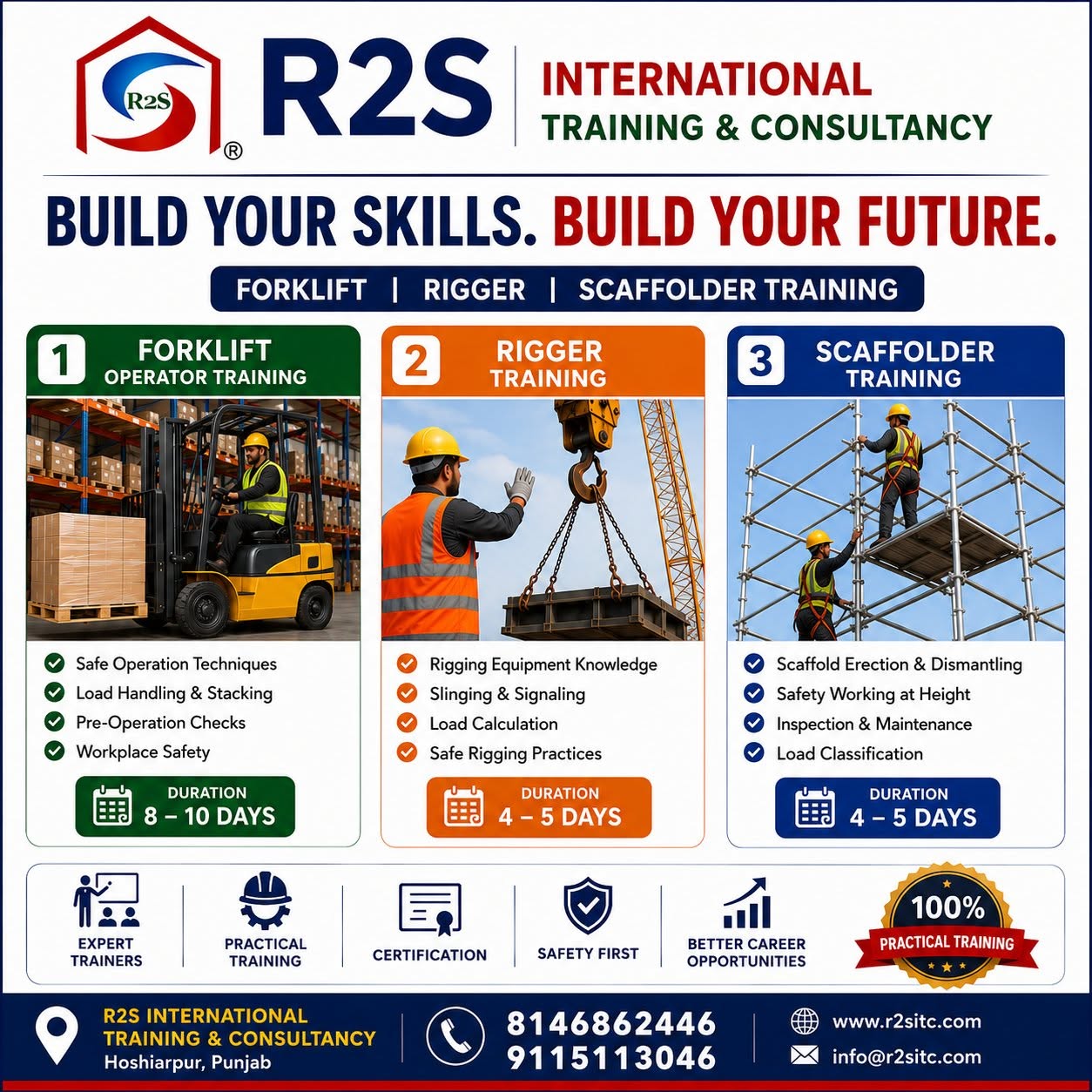
Modern industries depend on skilled workers who can operate equipment, handle materials, and work safely in challenging environments. Forklift operators, riggers, and scaffolders all play important roles in construction, manufacturing, warehousing, logistics, infrastructure, and other industrial sectors.
For students, freshers, job seekers, and working professionals, practical training in these areas can help develop valuable workplace skills and improve safety awareness.
At R2S International Training & Consultancy (R2SITC), Hoshiarpur, Punjab, practical industrial training is focused on developing technical knowledge, safe working practices, and hands-on skills.
🚜 Forklift Operator Training
Forklifts are commonly used for moving, lifting, loading, unloading, and stacking materials. Because forklifts operate around workers, vehicles, racks, and heavy loads, operators need proper training before performing these tasks.
What Does Forklift Training Cover?
A professional forklift operator course may include:
- Forklift controls and basic operation
- Safe driving and maneuvering
- Loading and unloading
- Material handling
- Safe stacking and unstacking
- Load stability and capacity awareness
- Pre-operation inspection
- Pedestrian and workplace traffic safety
- Safe parking procedures
- Workplace hazard awareness
Why Practical Training Matters
Hands-on forklift training allows participants to become familiar with the machine and practise safe operating techniques under instructor guidance.
Practical exercises may include:
Driving → Turning → Reversing → Load Handling → Stacking → Unloading
This practical experience can help improve confidence and reinforce safe operating habits.
🏗️ Rigger Training
Rigging is an important part of lifting and material-handling operations. Riggers help prepare and secure loads before they are lifted or moved using cranes, hoists, and other lifting equipment.
Improper rigging can result in unstable loads, equipment damage, or serious accidents. Training therefore focuses strongly on safe lifting practices.
Topics Covered in Rigger Training
Participants may learn about:
- Slings and shackles
- Hooks and lifting accessories
- Sling inspection
- Load attachment
- Load stability
- Centre of gravity
- Sling angles
- Safe lifting practices
- Crane signalling
- Communication with crane operators
- Workplace lifting hazards
🔗 Practical Rigging Skills
A practical rigger course can provide experience with:
- Selecting suitable lifting accessories
- Inspecting rigging equipment
- Connecting slings and shackles
- Securing loads
- Understanding load balance
- Using standard communication signals
- Maintaining safe distances from suspended loads
Participants should always follow applicable workplace procedures, equipment manufacturer’s instructions, and relevant safety requirements.
🏗️ Scaffolder Training
Scaffolding provides temporary platforms and access for workers performing construction, maintenance, repair, and industrial activities.
Because scaffolding is often used at elevated locations, correct assembly, inspection, access, and fall protection are extremely important.
What Can You Learn in Scaffolder Training?
A professional scaffolder course may introduce participants to:
- Scaffold components
- Scaffold terminology
- Safe erection and dismantling
- Platform safety
- Guardrails and toe boards
- Safe access and egress
- Scaffold inspection
- Load and stability awareness
- Fall protection
- Identification of scaffold hazards
Specialized scaffold erection and dismantling should be performed by appropriately trained and authorized personnel.
🦺 Why Forklift, Rigger & Scaffolder Training is Important
Although these three roles are different, they have one major requirement in common: workplace safety.
A trained worker needs to understand:
Hazard Identification
Recognizing unsafe conditions before beginning a task.
Equipment Inspection
Checking equipment and accessories for visible defects or other safety concerns.
Safe Work Procedures
Following established procedures rather than taking unnecessary risks.
Communication
Maintaining clear communication with supervisors and other workers.
PPE
Using the appropriate personal protective equipment for the task.
Who Should Consider These Courses?
These courses can be useful for:
- Students
- Freshers
- Job seekers
- Construction workers
- Warehouse employees
- Industrial workers
- Logistics personnel
- Maintenance workers
- Supervisors
- Experienced workers looking to improve their skills
The appropriate course depends on the individual’s job responsibilities and workplace requirements.
Career Opportunities
These skills can be relevant across several industries.
Forklift Operators
Potential workplaces include:
- Warehouses
- Logistics companies
- Manufacturing plants
- Distribution centers
- Construction sites
- Industrial facilities
Riggers
Potential sectors include:
- Construction
- Heavy engineering
- Infrastructure
- Manufacturing
- Power projects
- Shipyards
- Industrial lifting operations
Scaffolders
Potential sectors include:
- Construction
- Industrial maintenance
- Infrastructure projects
- Manufacturing
- Power plants
- Large-scale industrial projects
Job availability, salary, and employer requirements vary according to location, experience, qualifications, and industry.
Why Choose Practical Industrial Training?
When selecting a training institute, students should look for a program that combines theoretical knowledge with practical exposure.
Important factors include:
✅ Experienced instructors
✅ Practical demonstrations
✅ Appropriate training equipment
✅ Safety-focused curriculum
✅ Hands-on exercises
✅ Workplace hazard awareness
✅ Proper assessment
✅ Course completion certification
Practical learning helps participants understand how safety principles are applied in real working environments.
Build Multiple Industrial Skills
Workers who develop complementary skills can gain a broader understanding of industrial operations.
For example:
Forklift Training + Rigger Training + Scaffolder Training + HSE Training
can provide exposure to different areas of material handling, lifting operations, access systems, and workplace safety.
However, each role requires its own specific competence and authorization. Workers should only perform tasks for which they are properly trained and authorized.
Start Your Industrial Safety Training in Punjab
The demand for skilled industrial workers continues across construction, logistics, manufacturing, warehousing, and infrastructure. Developing practical skills while maintaining a strong focus on safety can help workers become better prepared for workplace responsibilities.
Whether you want to become a Forklift Operator, Rigger, or Scaffolder, professional training can help you understand equipment, workplace hazards, safe operating procedures, and practical techniques.
📍 R2SITC – Hoshiarpur, Punjab
R2S International Training & Consultancy (R2SITC)
📍 Hoshiarpur, Punjab
📞 +91-8146862446
📧 [email protected]
Develop practical industrial skills. Learn safer working practices. Prepare yourself for opportunities in construction, logistics, warehousing, and industrial operations. 🦺🚜🏗️