
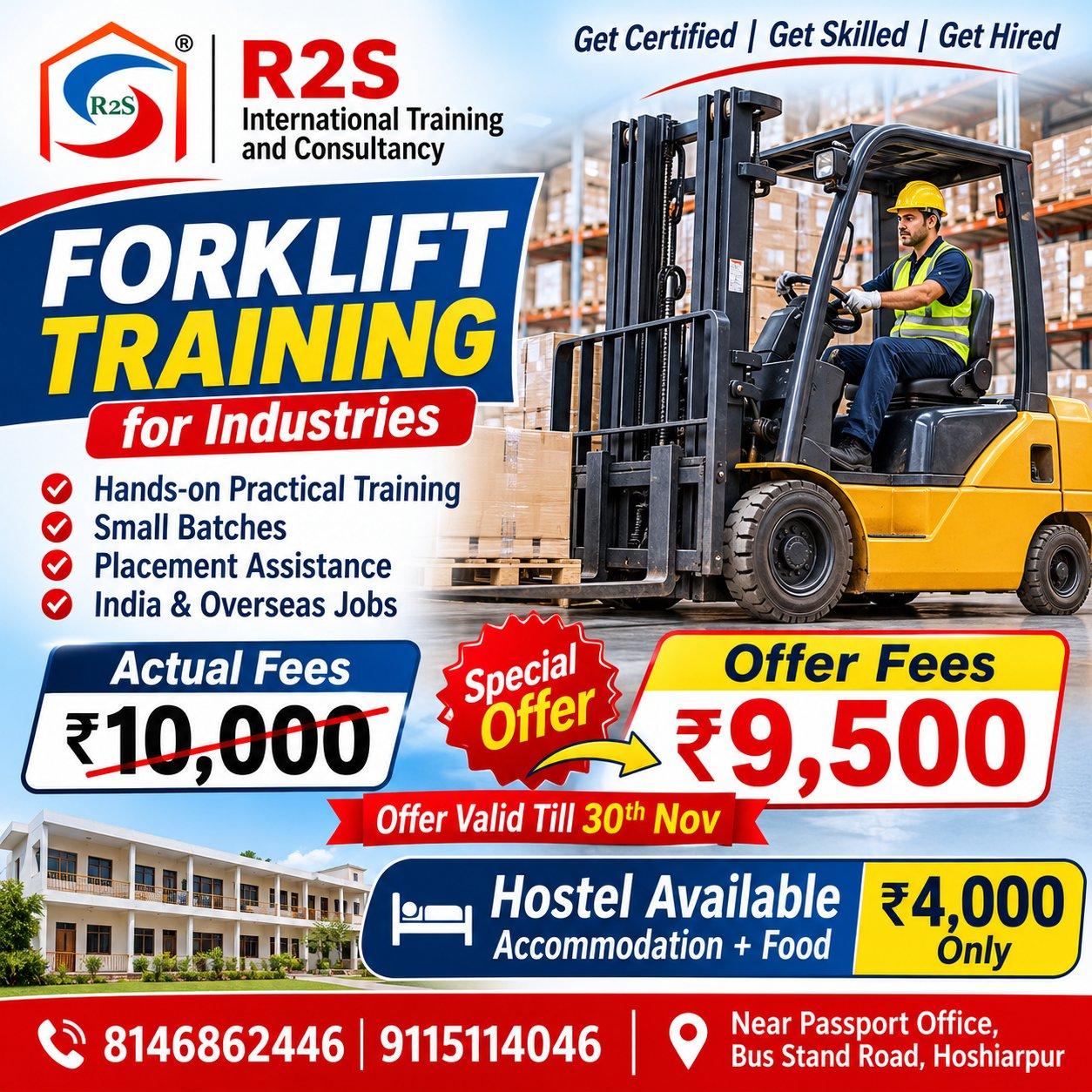
Forklifts play an important role in modern industries. From warehouses and manufacturing units to construction sites and logistics facilities, these machines help move, lift and organise heavy materials efficiently.
However, operating a forklift requires more than knowing how to drive a vehicle. Operators must understand machine controls, load capacity, stability, workplace conditions, pedestrian safety and correct operating procedures.
Without proper knowledge and training, forklift operations can lead to serious incidents, including collisions, falling loads, equipment damage and vehicle overturns.
This is why professional forklift training is important for individuals who want to develop the knowledge and practical skills required for forklift-related work.
At R2S International Training & Consultancy (R2SITC), Hoshiarpur, Punjab, interested candidates can enquire about forklift operator training and available learning opportunities.
1. What Is Forklift Training?
Forklift training is a learning process that introduces individuals to the safe operation and handling of powered industrial trucks.
A forklift is a material-handling vehicle designed to lift, carry and place loads over short distances. It is commonly used in warehouses, factories, distribution centres, construction sites and industrial facilities.
A trained operator should understand how the machine works, how to inspect it before use, how to handle different loads and how to identify potential workplace hazards.
A structured forklift training programme generally combines theoretical instruction, trainer demonstrations, supervised practical exercises and an assessment of the learner’s skills. The exact content depends on the equipment, training provider and applicable requirements.
2. Why Is Forklift Operator Training Important?
Forklifts carry heavy loads and often operate in areas where workers, pedestrians, vehicles and storage systems share limited space.
Training helps operators understand the risks associated with these conditions and develop safer working habits.
Some important reasons include:
Understanding forklift controls: Operators need to know how steering, braking, lifting, lowering and other controls work.
Safe load handling: Incorrect load positioning or exceeding the machine’s rated capacity can affect stability and increase the risk of an accident.
Workplace awareness: Operators must recognise pedestrians, blind corners, narrow aisles, uneven surfaces and other hazards.
Equipment inspection: Identifying visible defects before operation helps prevent unsafe equipment from being used.
Better operating practices: Training encourages smooth manoeuvring, controlled lifting and following workplace procedures.
Forklift training should be relevant to the type of truck and the conditions in which it will be operated.
3. Different Types of Forklifts Used in Industries
Different workplaces use different types of forklifts depending on their material-handling needs, available space and operating conditions.
Commonly used for lifting, transporting and placing materials in warehouses, factories and loading areas.
Designed for warehouse environments where goods need to be stored or retrieved from higher shelving in relatively narrow aisles.
Rough Terrain Forklift
Used in suitable outdoor environments, including certain construction and material-handling applications.
Electric Forklift
Commonly used in indoor material-handling environments. Battery charging and equipment-specific operating procedures are important considerations.
Each forklift type has different operating characteristics. Training should match the specific truck and attachments the operator is expected to use.
4. Essential Skills Every Forklift Operator Should Learn
A professional forklift operator needs a combination of technical knowledge, practical ability and safety awareness.
Important learning areas include:
A. Understanding forklift controls
Operators should understand the function of steering, accelerator, brake, parking brake, lifting controls, lowering controls, mast tilt and other equipment-specific controls.
B. Pre-operation inspection
Before using a forklift, operators should learn how to identify visible defects and check important components.
A basic inspection may include:
Tyres and wheels
Forks and fork locking arrangements
Mast and lifting chains
Hydraulic hoses and visible leaks
Brakes and steering
Horn, lights and warning devices
Seat belt and operator protection features
Fluid levels, where applicable
Any defect that could make the forklift unsafe should be reported, and the equipment should not be operated until it has been assessed and made safe.
C. Safe driving and manoeuvring
Operators should learn how to start, stop, steer, reverse and manoeuvre a forklift in a controlled manner.
They should also understand speed limits, turning space, visibility restrictions and the importance of following designated travel routes.
D. Load handling techniques
Correct load handling is one of the most important parts of forklift operation.
Operators should understand:
How to approach a load safely
Correct fork positioning
Load weight and rated capacity
Load balance and stability
Safe lifting and lowering
Stacking and unstacking procedures
Maintaining visibility while carrying loads
E. Parking and shutdown procedures
A forklift should be parked in its designated area using the manufacturer’s instructions and workplace procedures. Operators should understand how to lower the forks, secure the vehicle and complete the required shutdown steps.
5. Understanding Forklift Load Capacity and Stability
One of the most important concepts in forklift safety is load capacity.
Every forklift has a rated capacity specified by the manufacturer. This indicates the load the machine is designed to handle under stated conditions.
However, the actual lifting capacity can be affected by factors such as:
Load weight
Load dimensions
Load centre
Lift height
Attachment type
Forklift configuration
A load that is too heavy, unevenly distributed or incorrectly positioned can affect the forklift’s stability.
Operators should always refer to the machine’s capacity plate and manufacturer instructions. They should never assume that a forklift can safely lift a load simply because the forks can physically fit underneath it.
6. Important Forklift Safety Rules for the Workplace
Safe forklift operation requires attention to the machine, the load and the surrounding environment.
Here are some important safety practices:
1. Wear appropriate personal protective equipment: Follow workplace PPE requirements and wear a seat belt where the forklift is equipped with one.
2. Inspect before operating: Complete the required checks and report defects.
3. Never exceed rated capacity: Check the capacity plate and ensure the load is stable.
4. Maintain clear visibility: Travel in a direction that provides a clear view. Follow approved procedures when visibility is restricted.
5. Watch for pedestrians: Slow down and use appropriate warnings at blind corners and intersections.
6. Avoid sudden movements: Sudden braking, turning or lifting can affect load stability.
7. Keep clear of suspended or raised loads: Never allow people to stand or pass beneath an elevated load.
8. Use designated routes: Follow workplace traffic rules and maintain a safe distance from edges, ramps and loading docks.
9. Never carry unauthorised passengers: Use only equipment specifically designed and approved for carrying people.
10. Follow manufacturer instructions: Do not operate the forklift beyond its intended limitations.
These practices are consistent with forklift safety guidance published by OSHA.
7. Common Forklift Accidents and Their Prevention
Understanding common forklift-related incidents can help operators recognise why safety procedures matter.
| Common incident | Important preventive practice |
|---|---|
| Forklift overturning | Follow load limits and safe turning practices |
| Falling materials | Secure and balance loads correctly |
| Pedestrian collision | Follow traffic routes and pedestrian safety rules |
| Collision with racks or equipment | Maintain visibility and manoeuvre carefully |
| Equipment failure | Complete inspections and report defects |
| Loading dock incidents | Maintain safe clearance from edges |
Forklift safety is a shared responsibility. Operators, supervisors, pedestrians and employers all have a role in maintaining safe working conditions.
8. Industries Where Forklift Operators Are Needed
Forklifts are used across a wide range of industries for material movement and storage.
Some common sectors include:
Warehousing and distribution
Manufacturing and production
Construction and infrastructure
Logistics and transportation
Retail and wholesale storage
Food and beverage industries
Automobile and engineering industries
Industrial plants and factories
The type of forklift, operating environment and employer requirements may vary from one industry to another.
9. Who Should Consider Forklift Training?
Forklift operator training may be useful for:
Freshers interested in material-handling work
Individuals interested in warehouse operations
Construction and industrial workers
Helpers looking to develop equipment-related skills
Workers interested in logistics and manufacturing
Individuals seeking to improve their practical operating knowledge
Candidates should confirm the course’s eligibility requirements, practical components and assessment process before admission.
10. Career Opportunities After Forklift Training
Forklift operation is a specialised skill used in many material-handling environments.
Depending on their training, competence, experience and employer requirements, individuals may explore roles such as:
Forklift Operator
Warehouse Equipment Operator
Material Handling Operator
Industrial Forklift Operator
Loading and Unloading Operator
Warehouse Assistant with forklift responsibilities
Completing a training programme can help develop relevant knowledge and skills, but employment is not guaranteed. Employers may require practical assessments, additional experience, medical fitness or specific authorisations.
11. Why Consider Forklift Training at R2SITC Hoshiarpur?
Choosing the right training institute is an important step in learning how to operate industrial equipment safely.
Before enrolling, candidates should understand the balance between classroom instruction and practical learning. Theoretical knowledge helps learners understand equipment, operating procedures and hazards, while supervised practical training helps them develop familiarity with actual forklift controls and movements.
At R2S International Training & Consultancy (R2SITC), Hoshiarpur, Punjab, interested individuals can enquire about forklift training, practical learning arrangements and admission details.
Candidates can contact the institute to confirm:
Current course availability
Training syllabus
Theoretical and practical learning arrangements
Course duration and eligibility
Assessment process
Certificate details
Admission procedure
12. Enquire About Forklift Training in Punjab
Learning forklift operation involves more than driving a machine. It requires an understanding of load handling, equipment inspection, workplace hazards and safe operating procedures.
If you are looking for Forklift Training in Punjab, contact R2SITC Hoshiarpur to learn about the available training programme and admission process.
R2S International Training & Consultancy (R2SITC)
Phone: +91-8146862446
Email: [email protected]
Website: https://r2sitc.com/
Enquire today about Forklift Operator Training.
Frequently Asked Questions (FAQs)
1. What is forklift training?
Forklift training teaches individuals about forklift controls, equipment inspection, load handling, safe driving, workplace hazards and operating procedures.
2. Is practical training important for forklift operators?
Yes. Practical training helps learners understand how to operate the equipment, manoeuvre safely and handle loads under appropriate supervision.
3. What topics are covered in forklift operator training?
Depending on the programme, topics may include forklift controls, pre-operation checks, steering, load capacity, stability, lifting and lowering, stacking, pedestrian safety and parking procedures.
4. Can beginners join forklift training?
Many training programmes are designed for beginners as well as individuals seeking to improve their operating skills. However, eligibility depends on the training provider’s requirements.
5. Where are forklift operators commonly employed?
Forklift operators may work in warehouses, manufacturing facilities, construction sites, distribution centres, logistics companies and other industrial environments.
6. Does forklift training guarantee a job?
No. Training can help develop relevant skills, but employment depends on competence, experience, employer requirements and available vacancies.
7. Where can I enquire about forklift training in Hoshiarpur?
You can contact R2SITC Hoshiarpur at +91-8146862446 or [email protected] for information about current courses and admission details.