
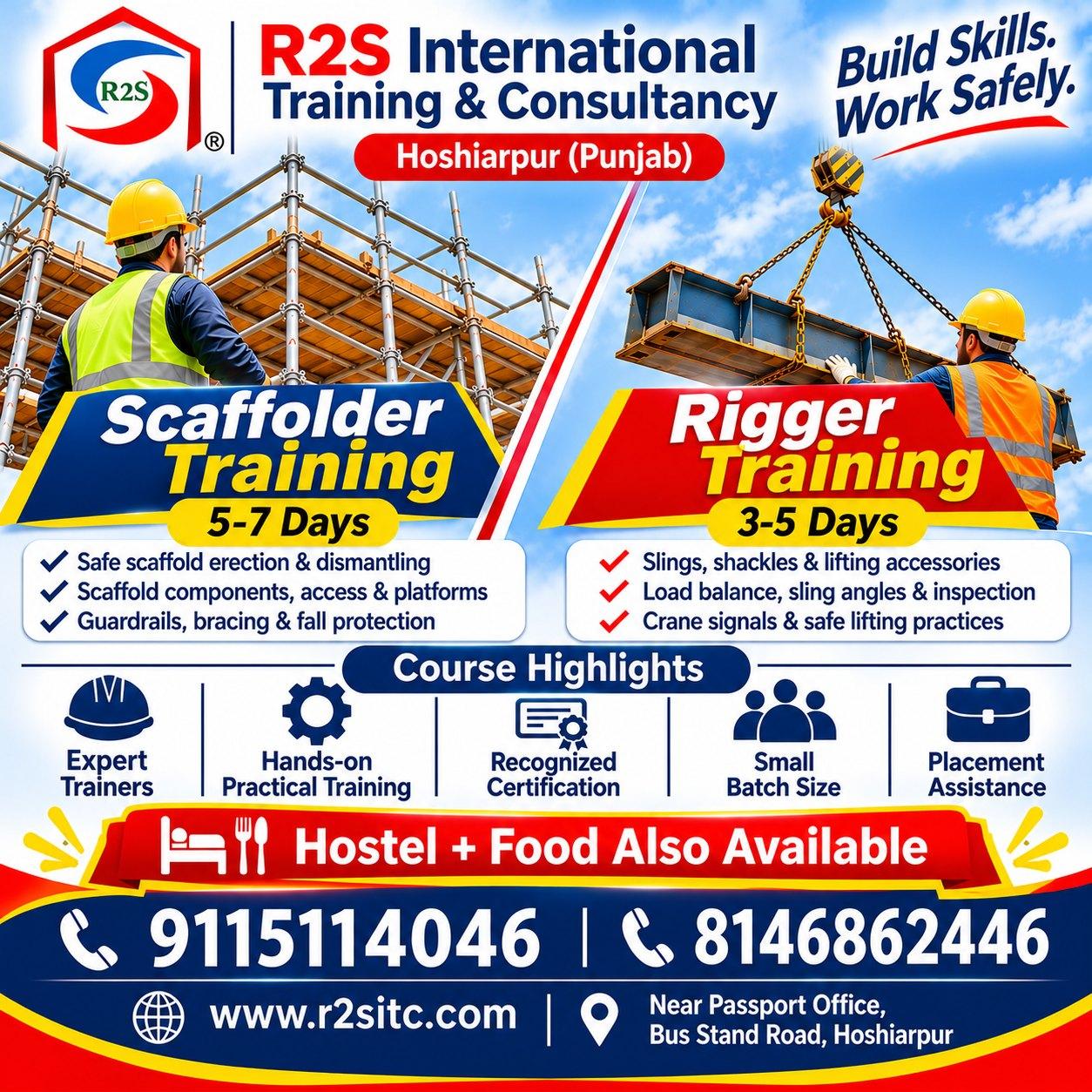
Construction sites, manufacturing facilities, infrastructure projects and industrial plants often involve work at height and the movement of heavy materials. These activities require trained workers who understand equipment, workplace hazards and safe working procedures.
Two important roles in these environments are scaffolders and riggers. Scaffolders help create temporary working platforms that provide safe access to elevated areas, while riggers assist with preparing, securing and handling loads during lifting operations.
Developing the right technical knowledge and safety awareness is essential for people entering these fields. Professional Scaffolder & Rigger Training can help learners understand the responsibilities, equipment and safe practices associated with these industrial roles.
At R2S International Training & Consultancy (R2SITC), Hoshiarpur, Punjab, individuals interested in industrial safety and construction-related skills can enquire about training opportunities in scaffolding and rigging.
1. What Is Scaffolder Training?
Scaffolder training focuses on the knowledge and skills required to understand scaffolding systems used in construction and industrial environments.
Scaffolding is a temporary structure that provides workers with access to elevated work areas. It may be required for activities such as building construction, maintenance, painting, inspection, repair and installation.
A scaffolder needs to understand how scaffold components work together and why correct assembly, stability, access and inspection are important.
Important areas of scaffolder training
Depending on the course syllabus and practical training arrangements, scaffolder training may cover:
-
Introduction to scaffolding and its applications
-
Types of scaffolding systems and their components
-
Scaffold tubes, couplers, frames and platforms
-
Basic principles of scaffold erection and dismantling
-
Safe access and working platforms
-
Scaffold stability, bracing and support
-
Fall prevention and fall protection awareness
-
Identification of damaged or unsuitable components
-
Scaffold inspection and hazard identification
-
Safe handling and storage of scaffolding materials
Scaffolding work must be appropriate to the structure, its intended use and the conditions at the worksite. Erection, alteration and dismantling should be performed by competent people under suitable supervision.
2. What Is Rigger Training?
Rigger training introduces learners to the principles of safely preparing, attaching and handling loads during lifting operations.
Rigging is an important activity on construction sites, industrial plants, warehouses, manufacturing facilities and infrastructure projects. Riggers work with lifting accessories and equipment to help ensure that materials are properly secured and moved according to the lifting plan.
A rigger must understand the characteristics of the load, the equipment being used and the potential risks involved in lifting and moving materials.
Important areas of rigger training
Depending on the syllabus, training may include:
-
Introduction to rigging and lifting operations
-
Types of lifting equipment and accessories
-
Wire rope slings, web slings and chain slings
-
Shackles, hooks and other rigging accessories
-
Basic load weight and centre-of-gravity awareness
-
Working Load Limit (WLL) and Safe Working Load (SWL) concepts
-
Sling selection and basic rigging arrangements
-
Inspection of lifting accessories
-
Load securing and handling awareness
-
Communication and signalling during lifting operations
-
Common lifting hazards and preventive measures
Lifting operations should be properly planned, appropriately supervised and carried out safely. Lifting accessories must be suitable for the task and subject to the required inspection and examination.
3. Difference Between a Scaffolder and a Rigger
Although both roles are important in industrial safety, their responsibilities are different.
| Scaffolder | Rigger |
|---|---|
| Works with temporary access structures | Works with lifting and load-handling activities |
| Understands scaffold components and systems | Understands lifting equipment and accessories |
| Focuses on scaffold assembly and dismantling | Focuses on preparing and securing loads |
| Works with platforms, tubes, couplers and frames | Works with slings, shackles, hooks and lifting gear |
| Focuses on stability, access and fall hazards | Focuses on load movement, equipment condition and lifting hazards |
Both roles require technical knowledge, hazard awareness, communication and compliance with site safety procedures.
4. Why Is Scaffolder and Rigger Training Important?
Working at height and handling heavy loads can involve serious workplace risks. A lack of knowledge, unsuitable equipment or incorrect working procedures can lead to falls, dropped objects, equipment failure and other incidents.
Professional training helps learners understand these risks and the importance of following established safety procedures.
Some important benefits include:
Better understanding of equipment: Learners become familiar with common scaffolding components, lifting accessories and their intended applications.
Improved hazard awareness: Training helps individuals recognise potential risks associated with working at height and lifting operations.
Understanding safe procedures: Learners gain awareness of why correct assembly, inspection, load handling and communication matter.
Workplace readiness: Technical knowledge and practical understanding can help individuals prepare for responsibilities in construction and industrial environments.
Safety-focused working habits: Training encourages workers to follow instructions, use suitable protective equipment and report unsafe conditions.
Training is an important part of developing competence, but it does not replace the need for appropriate supervision, experience and site-specific authorisation.
5. Essential Safety Practices Every Scaffolder Should Understand
Scaffolding safety involves more than assembling metal components. The structure must be suitable for the intended work and conditions.
Important safety practices include:
Check scaffold components
Components should be checked for visible damage, corrosion, deformation or other defects before use. Damaged or unsuitable parts should not be used.
Ensure proper foundation and stability
The supporting surface must be suitable for the scaffold and its expected loading. Bracing, ties and other stability measures should follow the applicable design and manufacturer instructions.
Maintain safe access
Workers should have suitable access to the working platform. Climbing scaffold frames or using unsafe access arrangements can create additional hazards.
Follow fall protection procedures
Suitable collective or personal fall protection measures should be selected according to the work and applicable safety requirements.
Respect load limits
Scaffold platforms should not be overloaded. Materials and equipment must be distributed and handled according to the scaffold’s rated capacity and design.
Ensure proper inspection
Scaffolds should be inspected by a competent person at the required stages and intervals, including after events or changes that may affect their safety.
6. Essential Safety Practices Every Rigger Should Understand
Rigging requires careful preparation because a suspended or moving load can create hazards for workers and nearby people.
Important safety practices include:
Understand the load
Before lifting, the load’s weight, dimensions, shape and centre of gravity should be considered as part of the lifting plan.
Select suitable lifting accessories
Slings, shackles, hooks and other accessories must be appropriate for the load and lifting arrangement. Their identification markings and rated capacities should be understood.
Inspect equipment before use
Lifting accessories should be checked for visible damage, wear, deformation and other signs that may affect their safe use. Equipment that is defective or unsuitable should be removed from service.
Maintain clear communication
Riggers, crane operators and other members of the lifting team need clear communication arrangements and agreed signals.
Keep people clear of suspended loads
Workers should stay away from hazardous lifting zones and never stand or work beneath a suspended load.
Follow the lifting plan
Lifting activities should follow the approved plan, site procedures and instructions of the responsible personnel.
7. Who Should Consider Scaffolder and Rigger Training?
This training may be useful for individuals who want to develop knowledge and skills for construction and industrial work.
Potential learners include:
-
Freshers interested in construction and industrial careers
-
Individuals seeking scaffolding-related skills
-
Workers interested in rigging and lifting operations
-
Construction site workers
-
Industrial maintenance personnel
-
Helpers and technicians looking to develop additional technical skills
-
Individuals interested in workplace health and safety
The appropriate course level depends on the learner’s previous experience, the type of work they intend to perform and the training provider’s syllabus.
8. Career Opportunities After Scaffolder and Rigger Training
Scaffolding and rigging skills are relevant to several industries where temporary access structures and lifting operations are required.
Depending on experience, competence, employer requirements and applicable certifications, related work areas may include:
-
Construction projects
-
Infrastructure development
-
Industrial plants
-
Manufacturing facilities
-
Warehousing and logistics
-
Maintenance and shutdown projects
-
Oil and gas projects
-
Shipbuilding and heavy engineering
Possible job roles may include scaffolding helper, scaffolder trainee, scaffolder, rigging helper, rigger trainee and rigger.
Important: Completing a training course does not automatically guarantee employment or eligibility for every job role. Employers may require additional experience, trade assessments, medical fitness, recognised certifications or site-specific authorisation.
9. Why Choose Professional Training at R2SITC Hoshiarpur?
Choosing appropriate training is an important step towards developing industrial skills. Learners should consider the course syllabus, trainer experience, practical learning opportunities, safety procedures and the relevance of the training to their career goals.
R2S International Training & Consultancy (R2SITC), located in Hoshiarpur, Punjab, provides training-related opportunities in industrial safety and technical skill development.
Individuals interested in Scaffolder and Rigger Training can contact the institute to enquire about:
-
Available course options
-
Training syllabus and learning objectives
-
Practical training arrangements
-
Course duration and eligibility
-
Assessment and certificate details
-
Admission process and upcoming batches
Contact the institute directly to confirm the current course structure and facilities before enrolment.
10. Enrol for Professional Scaffolder & Rigger Training in Punjab
Developing scaffolding and rigging knowledge can be a valuable step for individuals interested in construction, infrastructure and industrial work.
Understanding equipment, safe working procedures, lifting operations and hazard identification helps workers prepare for the responsibilities associated with these roles.
If you are looking for Professional Scaffolder & Rigger Training in Punjab, contact R2SITC Hoshiarpur to learn about available training programmes and admission details.
R2S International Training & Consultancy (R2SITC)
Hoshiarpur, Punjab, India
Phone: +91-8146862446
Email: [email protected]
Website: https://r2sitc.com/
Enquire today about Scaffolder & Rigger Training.
Frequently Asked Questions (FAQs)
1. What is Professional Scaffolder & Rigger Training?
It is training that introduces learners to scaffolding systems, lifting equipment, rigging accessories, workplace hazards and safety procedures used in construction and industrial environments.
2. What is the difference between scaffolding and rigging?
Scaffolding involves temporary structures and platforms used to access elevated work areas. Rigging involves preparing and securing loads for lifting and movement using suitable equipment and accessories.
3. Who can join Scaffolder and Rigger Training?
Freshers and individuals interested in construction, industrial maintenance, infrastructure and lifting-related work may enquire. Eligibility depends on the specific course requirements.
4. Is practical training important for scaffolders and riggers?
Yes. Practical learning helps individuals become familiar with equipment, components, work procedures and potential hazards. The practical content should match the course syllabus and the learner’s level.
5. What equipment is used in rigging?
Common rigging equipment includes wire rope slings, web slings, chain slings, shackles, hooks and other approved lifting accessories. The correct equipment depends on the lifting task.
6. Can scaffolder and rigger training help with industrial career opportunities?
Training can help develop relevant technical knowledge and safety awareness. Employment depends on the individual’s competence, experience, employer requirements and applicable certifications.
7. Where can I enquire about Scaffolder and Rigger Training in Punjab?
You can contact R2SITC in Hoshiarpur, Punjab, at +91-8146862446 or [email protected] for current course details.